


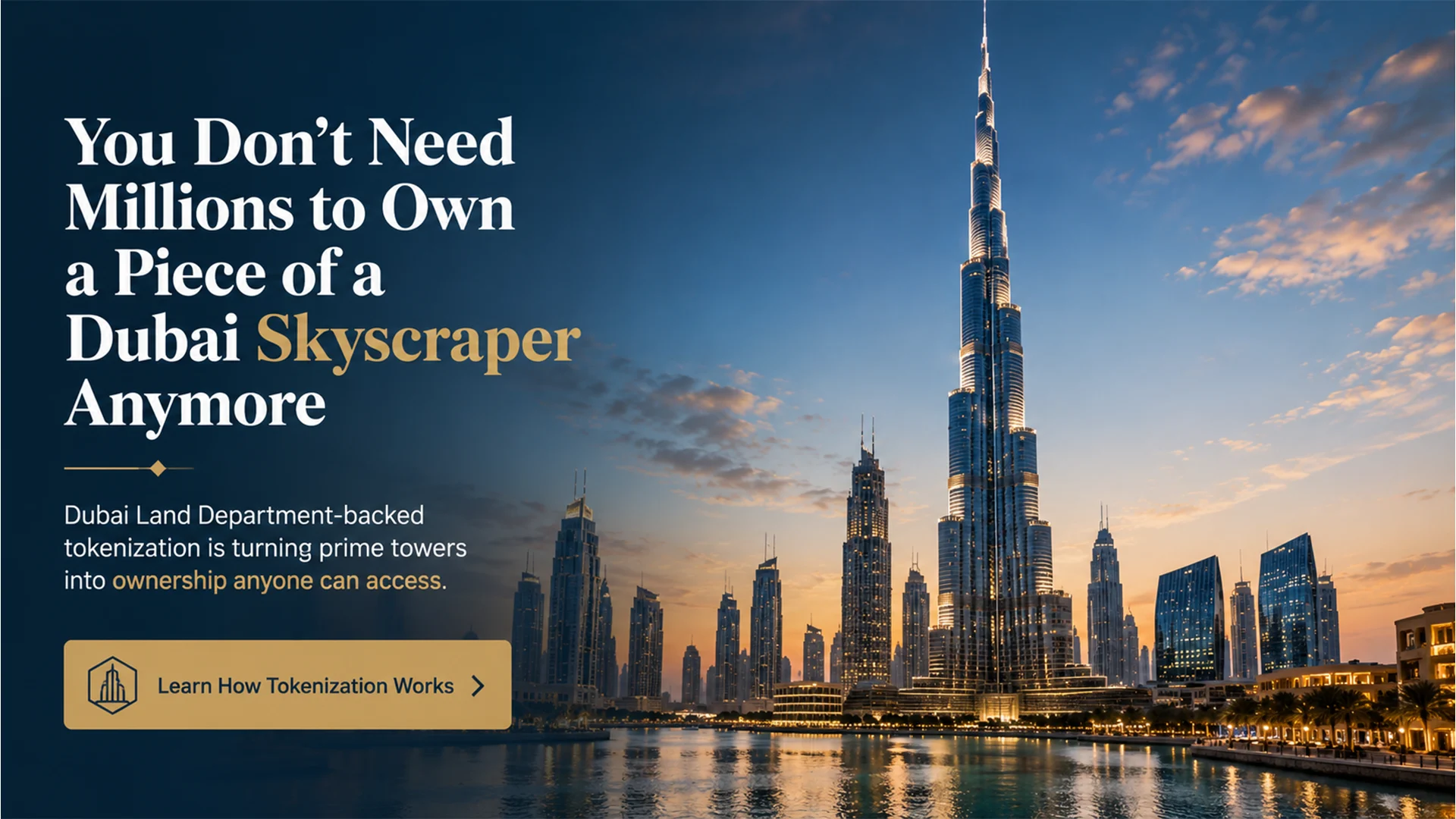
For decades, prime real estate belonged to those who could write very large cheques.
A skyline-defining tower in Dubai was something you admired, not something you expected to own. That assumption is beginning to change.
Today, technology is making it possible to buy a legally structured fractional interest in real estate, allowing multiple investors to own a share of the same property. This model is known as tokenized real estate, and Dubai is quickly becoming one of the most credible markets, bringing it into the mainstream.
What Is Tokenized Real Estate?
Tokenized real estate converts ownership in a physical property into digital units, or tokens.
Each token represents a proportional stake in the underlying asset. Instead of purchasing an entire apartment, office, or tower, investors can acquire a fraction of it and participate in its potential rental income and capital appreciation.
The property remains tangible. The ownership structure becomes more accessible.
Why Dubai Is Leading This Shift
Dubai has built its reputation by moving early on transformative ideas. Tokenized real estate fits naturally into that vision.
The Dubai Land Department has already launched regulated initiatives that connect blockchain-based ownership records with the official property registry. Platforms such as PRYPCO are helping bring fractional ownership to market within a supervised legal framework.
That matters because this is not a speculative concept. It is a government-backed evolution of how property ownership can work.
What This Means for Investors
Tokenization changes one fundamental aspect of real estate: access.
Investors who once had to commit substantial capital to enter premium markets can now participate with smaller allocations while maintaining exposure to the same underlying asset class.
This opens the door to:
Diversification across multiple properties
Lower barriers to entry
Greater transparency in ownership
Potentially improved liquidity through regulated secondary markets
In simple terms, real estate becomes more flexible without losing its intrinsic value.
Is It Real Ownership?
That is the question sophisticated investors ask first. In a properly regulated structure, the answer is yes. The token represents a legally recognized economic interest tied to a real property.
What you are buying is not a digital collectible. It is a structured ownership stake in an income-producing asset.
Why This Matters Now
The world’s wealthiest investors have long used fractional ownership, syndicates, and private funds to access landmark assets. Tokenization applies that same principle with greater efficiency and broader accessibility.
It transforms real estate from an asset that required concentration into one that allows precision.
Conclusion
Owning a fraction of a Dubai skyscraper is no longer a futuristic idea. It is a practical, regulated, and increasingly attractive way to access one of the world’s most dynamic property markets.
For investors seeking exposure to premium real estate without committing to full ownership, tokenization offers something powerful: A seat at the table once reserved for a select few.