

In 2025, the world's wealthiest people did something that would have seemed improbable a decade ago: they voted with their passports and pointed them at Dubai.
While London shed 16,500 millionaires in a single year and Paris, Berlin, and Hong Kong watched capital walk out the door, Dubai welcomed a record 9,800 high-net-worth individuals. Not tourists. Not short-term visitors. Residents.
That is not a real estate talking point. That is a structural, generational shift in where the world's wealth is anchoring itself and understanding it is essential for anyone serious about capital preservation, lifestyle, or long-term investment.
1. Zero Tax. No Exceptions.
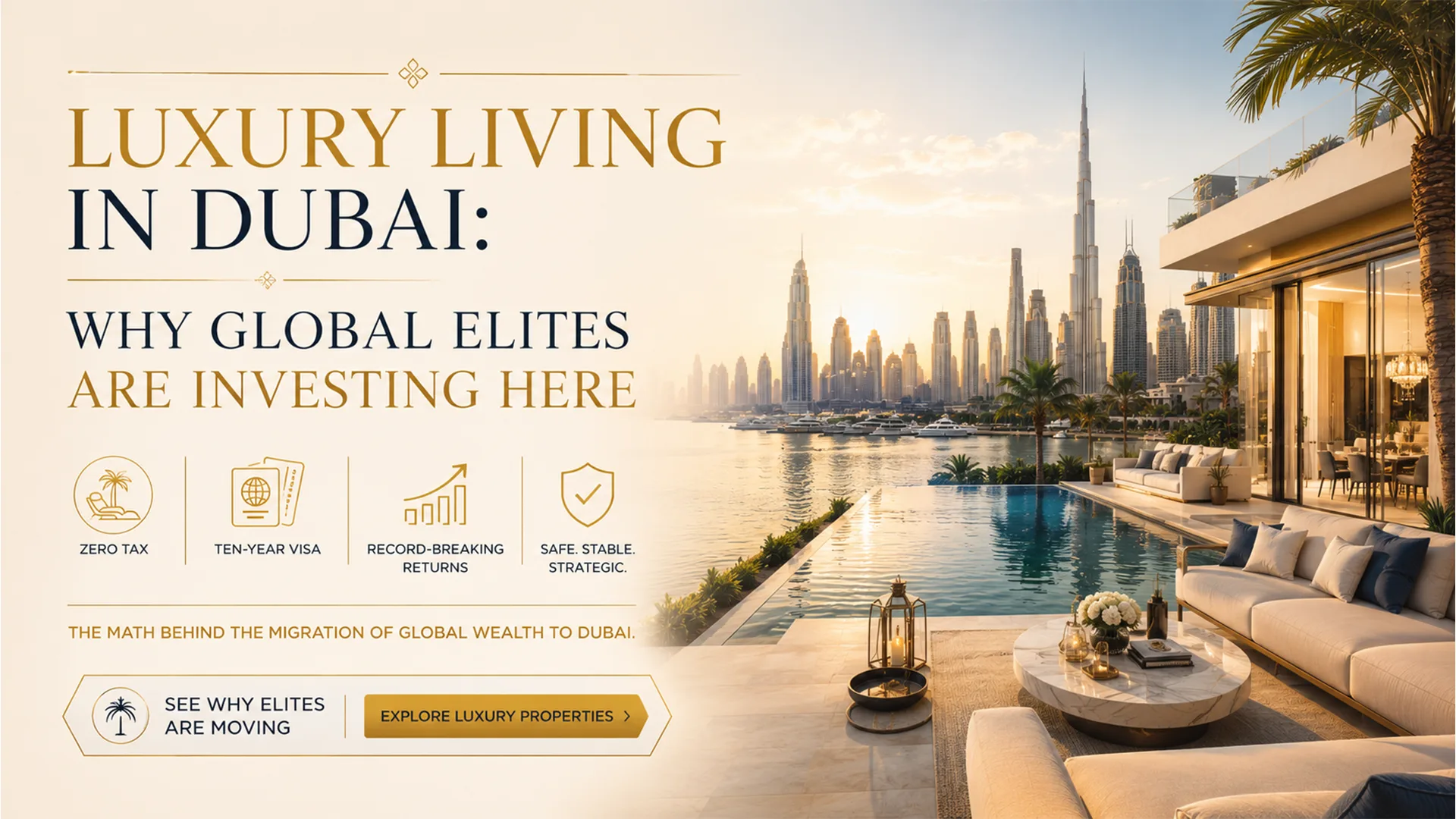
This is where the conversation usually starts and rightfully so. The UAE levies zero personal income tax, zero capital gains tax, and zero inheritance tax. For a tech founder relocating from the UK, a fund manager leaving France, or a business family moving from India, the financial arithmetic is immediate and decisive.
While European economies impose marginal income tax rates exceeding 55% in some countries, Dubai offers complete personal tax freedom. Add a currency pegged to the US dollar, and you have an environment built for wealth preservation - not erosion.
The numbers reflect this appeal: in 2025 alone, the UK recorded a net outflow of roughly $92 billion in private wealth, largely headed to the UAE, according to Henley & Partners. Dubai did not simply attract those millionaires. It converted them from visitors into residents.
2. The Golden Visa: Residency Without the Red Tape
Introduced in 2019 and significantly expanded in 2022, the UAE Golden Visa has rewritten the rules of elite migration. Investors who purchase real estate worth AED 2 million or more qualify for a renewable 10-year residency visa with no requirement to live in Dubai full-time and no local sponsor needed.
For globally mobile families, this is a game-changer. You gain long-term legal residence, the ability to sponsor family members, access to world-class schools and hospitals, and a home base in one of the most connected cities on earth, all without surrendering your primary citizenship or lifestyle.
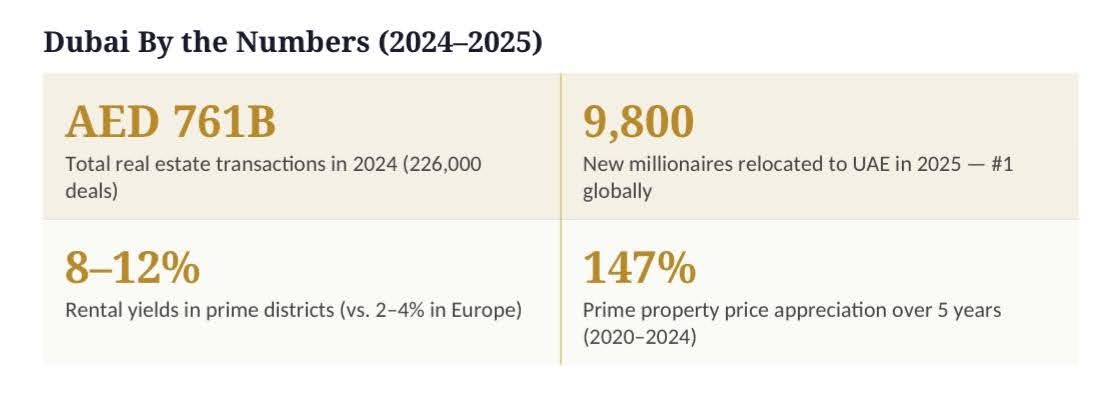
The results speak directly. The UAE attracted 6,700 new millionaires in 2024. In 2025, that figure rose to 9,800, the highest of any country in the world, surpassing the United States (7,500), Italy (3,600), and Switzerland (3,000), according to the Henley Private Wealth Migration Report.
3. A Real Estate Market That Keeps Breaking Records
Dubai's property market is not riding a single wave. It is a market with structural, multi-layered momentum and the data makes that clear.
In 2024, average residential sales prices rose 20% and rental rates climbed 19%, according to Deloitte's annual Dubai Real Estate Predictions report. Villa prices surged 26% year-over-year, with villa transactions in Q1 2025 alone reaching AED 53.4 billion - a 65% jump over the prior year.
At the ultra-luxury end, Knight Frank reported 435 transactions above $10 million in 2024, the highest on record. In Q4 2025, a six-bedroom Business Bay penthouse sold for $149.7 million, setting a new benchmark. The UAE luxury residential real estate market, valued at $45.11 billion in 2025, is forecast to reach $70.91 billion by 2030 at a 9.47% CAGR.
Prime Dubai property has appreciated 147% over five years. Compare that to savings accounts, bonds, or most equity markets, then ask yourself what a 'safe' investment really means.
Rental yields average 8 - 12% in prime locations like Dubai Marina and Palm Jumeirah far above the 2 - 4% typical in London, Paris, or New York. And unlike many western markets, 70% of acquisitions in Dubai close in cash, reflecting the caliber of buyer and the absence of interest-rate sensitivity in the market.
4. Lifestyle That Legitimizes the Investment Thesis
Numbers alone do not move people across continents. Dubai's sustained elite migration is also a lifestyle vote and the city has earned it.
Year-round sunshine. A cosmopolitan population from over 200 nationalities. World-class private schools and healthcare facilities. Branded residences co-developed with Bugatti, Lamborghini, Bentley Home, Armani, and Six Senses. Michelin-starred dining, cultural districts, and one of the world's busiest international airports - 10 hours or less from virtually any major financial capital.
Dubai welcomed 18.7 million overnight visitors in 2024, a 9% increase over the prior year, with hotel occupancy reaching 78%. Office space in premium towers like ICD Brookfield in DIFC maintained occupancy above 95%. These are not the metrics of a speculative boom. They are the metrics of a city that functions at the highest level.
5. Policy, Infrastructure, and Vision Built for the Long Game
What separates Dubai from other tax-friendly destinations is the institutional seriousness behind its ambitions. The Dubai 2040 Urban Master Plan, the Real Estate Strategy 2033, and the Economic Agenda D33 are not branding exercises. They are government-backed frameworks designed to double the real estate sector's contribution to GDP and position Dubai as the most liveable city on earth by 2040.
Infrastructure investment is continuous and visible: new metro corridors, smart city initiatives, free zones expanding financial flexibility for business owners, and developer oversight mechanisms that protect buyers from project risk.
With GDP growth projected at 5.1% in 2025 by the IMF and a population that grew 5% to over 3.8 million in 2024, Dubai's growth engine is not reliant on any single sector or cycle. Its diversification from real estate and tourism to finance, logistics, and technology provides the kind of structural depth that gives long-term investors genuine confidence.
Who Is Actually Moving Here?
The profile of Dubai's new resident is not the clichéd free-spending oligarch. It has evolved significantly. Today, the typical high-net-worth migrant is a founder, operator, fund manager, or multi-generational family office, seeking a base that combines tax efficiency, legal stability, mobility, and quality of life for their families.
Notable recent relocations include:
Tech billionaires and founders escaping unfavorable capital gains environments in the US and Europe
British wealth managers and family offices following the 'Wexit' triggered by the UK's 2024 Budget changes
Indian and Asian business families drawn by proximity, cultural familiarity, and DIFC's private banking ecosystem
Global investors from Russia, France, Germany, and Spain redirecting capital from increasingly volatile home markets
Average residential purchases by this cohort run AED 11.4 million per transaction. Ultra-high-net-worth families commit AED 134 million or more for legacy villas and waterfront compounds, per Betterhomes. These are not speculative plays. They are permanent capital allocations.
The Bottom Line
Dubai is not having a moment. It is completing a transformation from a regional luxury destination into a permanent global wealth capital.
The fundamentals are aligned in a way that rarely holds simultaneously in any single market: strong yield, consistent price appreciation, tax-free residency, world-class infrastructure, political stability, and genuine demand from the world's most financially sophisticated individuals.
For global elites evaluating where to invest, where to live, and where to build legacy - Dubai is no longer a compelling option among many. For a growing number, it is simply the obvious answer.
The question is no longer why Dubai. The question is: how early and how much.
FAQs
Q: Can foreigners actually own property in Dubai - outright?
Yes, full freehold ownership in designated zones. No local sponsor, no restrictions, no asterisks.
Q: What's the real return on luxury property here?
8–12% rental yields, 20% annual price growth in 2024, and 147% appreciation over five years - numbers most global markets haven't seen in a generation.
Q: Do I need to live in Dubai to qualify for the Golden Visa?
No. Buy AED 2M+ in property, get a 10-year renewable residency - no full-time stay required.
Q: Is Dubai's property market still growing, or did I miss the window?
The Dubai Land Department just launched Phase II of its Real Estate Tokenisation Project in February 2026, new infrastructure, new liquidity, new buyers. The window isn't closing; it's widening.