

Most cities make you feel like a guest. Dubai is increasingly making you an offer.
And right now, that offer just got cleaner, faster, and more accessible than at any point in the UAE's history. In April 2026, two of Dubai's most powerful institutions - the General Directorate of Identity and Foreigners Affairs (GDRFA Dubai) and the Dubai Land Department (DLD) signed a landmark agreement that collapses what was once a fragmented, bureaucratically exhausting process into a single, unified digital platform.
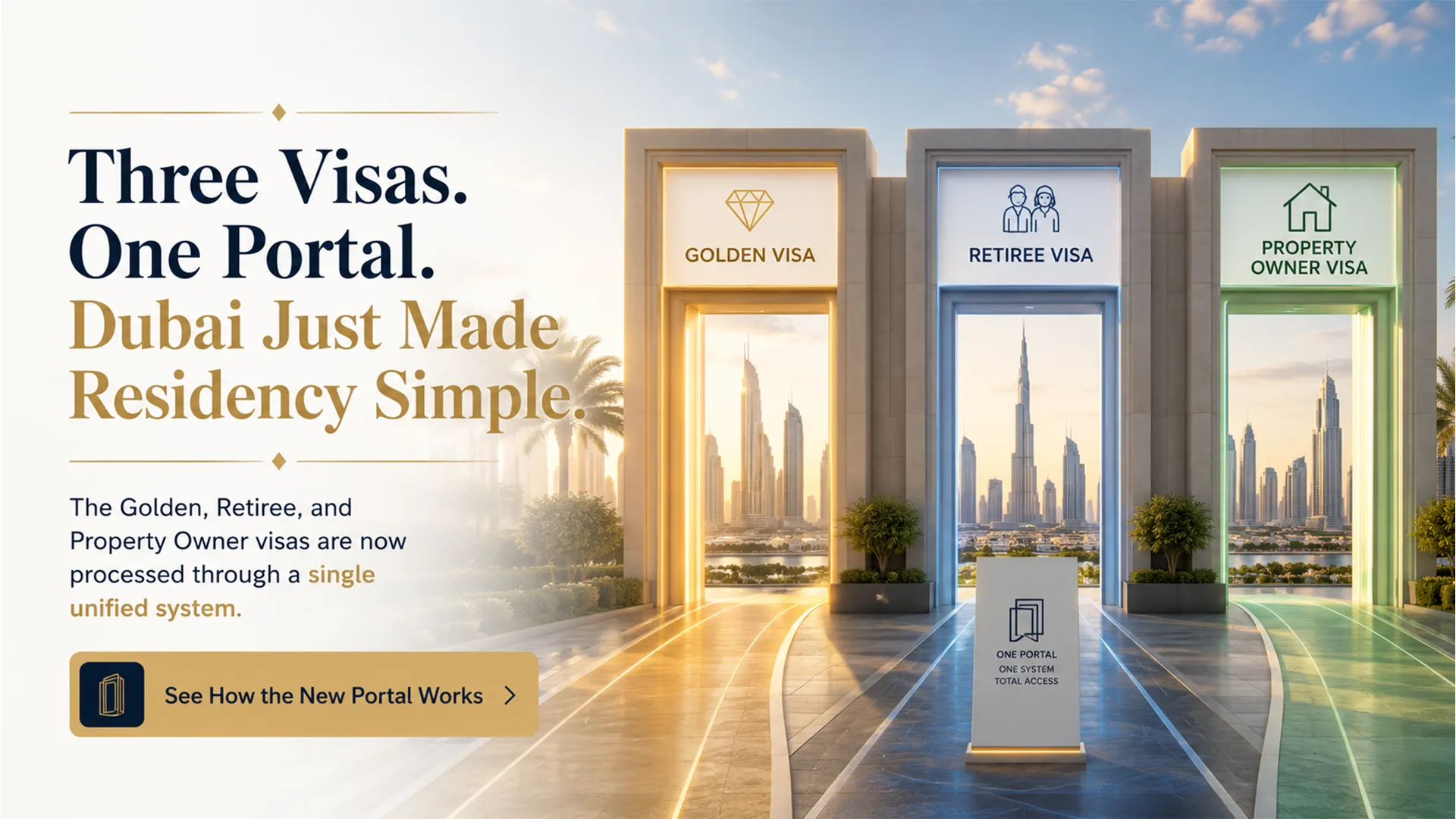
Three residency pathways. One portal. One submission. Done.
This is not a minor administrative update. It is a signal and for anyone who understands how Dubai communicates its ambitions, signals are worth paying attention to.
The Old System Was the Problem
To understand why this matters, you need to understand what it replaced.
Until April 2026, applying for property-linked residency in Dubai meant navigating two separate government bodies that did not speak to each other in real time. Property verification happened at the DLD. Visa processing happened at GDRFA. Between them sat a gap, filled with duplicate paperwork, manual reconciliation, and a waiting game that belonged to an older era of governance.
For an individual investor, this was an inconvenience. For a family office managing multiple properties across portfolios, or a corporate mobility team relocating executives, it was a genuine operational friction point, the kind that makes decision-makers hesitate, delay, or look elsewhere.
Dubai noticed. Dubai responded.
What the Platform Actually Does
The new unified system, which went live on April 16, 2026, consolidates three previously separate residency pathways into a single end-to-end digital channel. This is managed by GDRFA Dubai, with DLD feeding real-time property valuations and title verifications directly into the backend.
The three pathways now processed through this single portal are:
The Golden Residency - the ten-year renewable visa that has become the global benchmark for investor residency programmes, requiring a qualifying property valuation of AED 2 million.
The Retiree Residency - a five-year pathway designed for those who want to plant roots in Dubai without the pressures of active investment, with property ownership as one of the qualifying routes.
The Property Owner Visa - the shorter-term residency that allows real estate investors to live in Dubai tied directly to their registered ownership.
All three. One portal. Document submission, property verification, and approval handled end to end in a single system, with most steps completable remotely. Only the biometric appointment requires physical presence.
The Reform That Runs Alongside It
The portal unification did not arrive alone.
In February 2026, a separate policy circular quietly rewrote one of the most significant barriers to the Golden Visa's property route. Previously, applicants had to demonstrate that they had paid at least half of a qualifying property's value upfront, a requirement that excluded off-plan buyers, those using mortgages, and investors structuring their acquisitions across payment plans. That requirement is gone.
Eligibility for the ten-year Golden Residency through property is now determined by one metric alone: the DLD-certified valuation reaching the AED 2 million threshold. How you paid for it, when you paid for it, and what your payment schedule looks like - none of that is relevant anymore. Off-plan qualifies. Mortgaged properties qualify. Combined title deeds qualify.
This is the kind of policy shift that changes who can access the most prestigious long-term residency in the region without changing the headline number that gives it its weight.
Why This Matters More Than It Sounds
There is a version of this story that reads as dry regulatory news. That version is missing the point.
What Dubai has done is remove friction from the relationship between property investment and long-term residency. These two things have always been connected in the UAE - the ability to own an asset and simultaneously earn the right to live, operate, and build a life around it. But the mechanics of that connection were clunky. Investors had to earn their residency twice: once by meeting the threshold, and again by surviving the administrative process.
That second test is now substantially easier. And for the global investor, the family in Mumbai planning a second home, the entrepreneur in London repositioning assets, the high-net-worth individual in Geneva thinking about where to anchor the next decade, ease matters enormously. Time is capital. Process friction is a cost. Dubai just reduced both.
The Tokenization Signal Worth Watching
During the signing of the MoU, GDRFA Dubai's director general specifically praised the DLD's real estate tokenization initiatives as having "strengthened system integration and created an advanced environment" that supports this partnership. That language is deliberate.
Dubai is actively running regulated real estate tokenization pilots, a framework that allows fractional, blockchain-verified ownership of property. While tokenized holdings do not yet qualify for residency purposes, the architecture is being built. The pipes are being laid. The officials who signed the April agreement are the same officials overseeing the tokenization ecosystem.
What this hints at carefully, without confirmation, is a future where assembling a qualifying property portfolio could happen through fractional positions rather than a single whole-unit purchase. If that becomes policy, the implications for global investor access would be extraordinary. Watch this space.
What This Means If You Are Considering Dubai Property Right Now
If you have been watching Dubai's real estate market with interest but hesitating at the operational complexity of turning a property purchase into a residency, that barrier has been materially reduced.
The portal is live. The upfront payment requirement for the Golden Visa is gone. The process is digital, centralised, and faster than anything that came before it. And the underlying asset market, particularly following the Sheikh Zayed Road freehold announcement and the sustained demand across premium Dubai addresses has never been more active.
Dubai is not making it easier to invest by lowering its standards. It is making it easier to invest by removing the friction that was never necessary in the first place. That distinction matters, because it means the quality of what you are buying into has not been diluted. The commitment is unchanged. The path to get there is simply cleaner.
Dubai's Broader Message
Both officials who signed the April MoU explicitly linked this integration to Dubai's D33 Economic Agenda, the emirate's plan to double its GDP within a decade by attracting a significant wave of new investors and high-skilled professionals.
The unified portal is not a standalone product, but an infrastructure in service of an ambition. Dubai is building a city where the relationship between ownership, residency, and belonging is frictionless where buying property is not the beginning of a bureaucratic journey, but the end of one.
For investors who are serious about where they put their money, and serious about what their money can unlock, the direction of travel here is clear.
The portal is open. The question is whether you walk through it.
Thinking about making Dubai your investment home? The conversation starts with the right property and the right team behind you.