

By the time most people hear about a market shift in Dubai, the smart money has already moved.
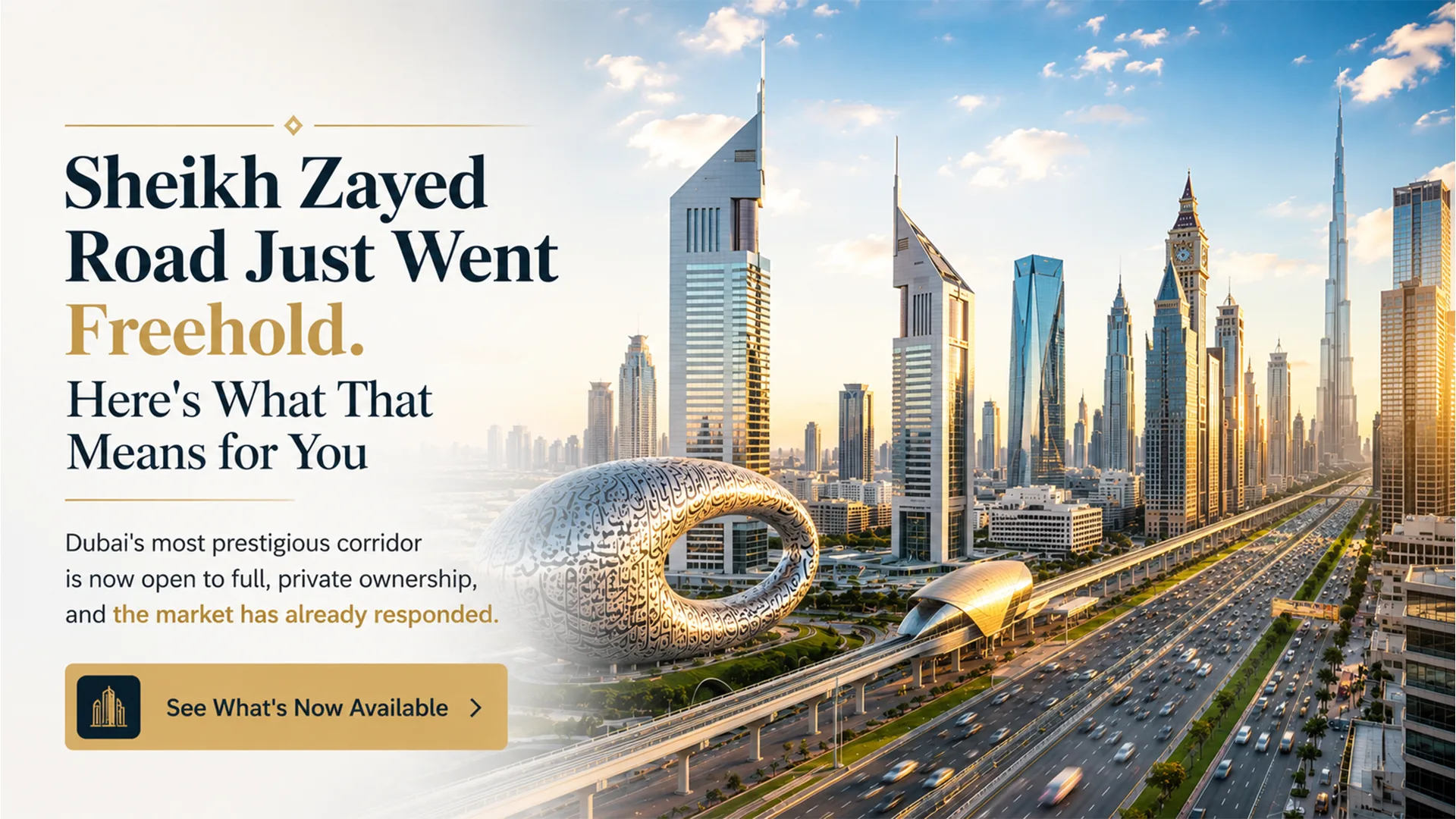
That's the quiet truth behind what happened in January 2025 and what is still unfolding today. The Dubai Land Department made an announcement that, on the surface, read like bureaucratic policy. In reality, it rewrote the rules of one of the world's most valuable stretches of real estate: Sheikh Zayed Road.
The road that doesn't sleep. The spine of a city that refuses to slow down. It just went freehold
This Is Not a Small Change
For decades, properties along Sheikh Zayed Road operated under leasehold ownership - a structure that capped ambition. You could hold it. You could use it. But you never truly owned it, not in the way that commands global investor confidence.
That chapter is over.
The Dubai Land Department has opened the door for private property owners along Sheikh Zayed Road from the Trade Centre Roundabout to the Dubai Water Canal to convert their properties to full freehold status. Open to all nationalities. Permanent ownership. Perpetual title. This is the kind of policy move that cities make once in a generation.
Why Sheikh Zayed Road Changes Everything
There is a difference between owning property in Dubai and owning property on Sheikh Zayed Road.
This is the corridor that houses the financial nerve centre of the UAE. DIFC sits on it. World Trade Centre anchors it. Downtown Dubai bleeds into it. It is the address that signals arrival for corporations, for families, for investors who understand that location is not just geography, it is legacy.
Until now, the finest addresses on this road came with an asterisk. Freehold ownership was something you could find in Dubai Marina, in Business Bay, and on Palm Jumeirah. Sheikh Zayed Road, the most iconic of them all, remained largely beyond reach for true ownership. That asymmetry has been corrected.
What Full Ownership Actually Means
Freehold is not just a legal term. It is a shift in power.
When you hold a freehold title, you own the property and the land beneath it indefinitely. You can sell when you choose, lease on your terms, renovate without seeking permission from a ground landlord, and pass it to your heirs without restriction. You are not a long-term tenant with a sophisticated lease. You are an owner.
For investors, this unlocks something profound: the ability to hold, compound, and exit on your own timeline, anchored to an asset in one of the most visible corridors in the world. For end-users - families, business owners, executives who want to plant a flag, it means permanence in a city that rewards commitment.
The Market Has Already Responded
Markets do not wait for press releases. The moment the announcement landed, the data began to move.
Ready properties along Sheikh Zayed Road saw price appreciation that outpaced virtually every other established freehold zone in Dubai through the first half of 2025. The velocity was sharper than even the most optimistic projections from industry analysts had been calling this a game-changer from day one.
The CEO of fäm Properties, Firas Al Msaddi, described the move as "a win for all stakeholders." Mohanad Alwadiya of Harbor Real Estate called it "the beginning of a tangible shift in the real estate landscape along Sheikh Zayed Road from restricted ownership to an open investment market."
These are not cheerleaders. These are professionals who watch Dubai's property market the way traders watch a Bloomberg terminal.
The Projects That Tell the Story
The first freehold residential and commercial project to launch on Sheikh Zayed Road was AA Tower - a sixty-storey address that sold at a pace that surprised even its developers. It signals a pipeline.
Three more existing towers are reportedly in line to follow the same path. And then there are the newcomers: Trump Tower is under construction on this corridor. Burj Azizi, which will claim its place among the world's tallest, is rising here too. Jumeirah Emirates Towers Residences has entered the freehold conversation. Sheikh Zayed Road is not being discovered but being unlocked.
What was once the most prestigious address in Dubai that you couldn't truly own is now becoming the most prestigious address in Dubai that you can.
Who This Is For
It is tempting to see this as news for the ultra-wealthy alone. But the range of opportunity here is wider than that.
For the seasoned investor, this is a chance to anchor a portfolio in an address that carries a weight no off-plan development can manufacture. Sheikh Zayed Road does not need to be explained to a buyer in Singapore or a family office in London. It speaks for itself.
For the business owner, freehold commercial space on this corridor offers something rare: permanence at the centre of Dubai's commercial gravity. The ability to own your headquarters not lease it, changes your balance sheet and your legacy.
For the individual buyer, this is an entry point into an address that has never been accessible in this way before. And in markets like Dubai, the first wave of access is typically the one that delivers the strongest long-term returns.
What You Need to Know About the Process
The conversion from leasehold to freehold is a structured process administered by the Dubai Land Department. Eligible property owners can verify their status through the Dubai REST app, submit an application for land assessment and valuation, and proceed through DLD's framework, which includes a conversion fee calculated on the property's assessed value, along with service charges set by RERA.
The process is transparent. The infrastructure is in place. And for new buyers, the freehold title will come as standard, no legacy conversion required.
The Bigger Picture: Dubai Real Estate Strategy 2033
This announcement does not exist in isolation. It is a deliberate move within Dubai's Real Estate Strategy 2033, a long-term framework designed to double real estate's contribution to GDP, deepen home ownership rates, and ensure Dubai remains the world's most investable property market.
Opening Sheikh Zayed Road to freehold ownership is an intention.
Dubai has always made the boldest moves when others were still studying the playbook. The freehold decree of 2002, which first allowed foreign ownership in designated areas, is widely credited with igniting the international investment surge that built the Dubai we know today. January 2025 may one day be remembered in the same breath.
The Window Is Open, But Windows Close
The plots eligible for this conversion are finite. Sheikh Zayed Road is built up, storied, and irreplaceable. There is no version of this story where supply suddenly expands dramatically. What exists, exists. What becomes freehold becomes permanently scarce.
Early movers in Dubai's freehold zones, those who bought in Dubai Marina or Downtown in the years immediately following their designation, understand what this moment can mean. They did not wait for consensus. They read the policy, understood the direction, and acted while others were still asking questions.
The question now is not whether Sheikh Zayed Road is a compelling investment address. It always was. The question is whether you are going to be part of its next chapter.
Ready to explore ownership opportunities on Sheikh Zayed Road? The conversation starts now.