


Most cities talk about sustainability the way corporations talk about ethics: loudly, and at a careful distance from anything that costs money.
Dubai is doing something different. It is making sustainability mandatory, measurable, and, critically for anyone holding property here, financially consequential.
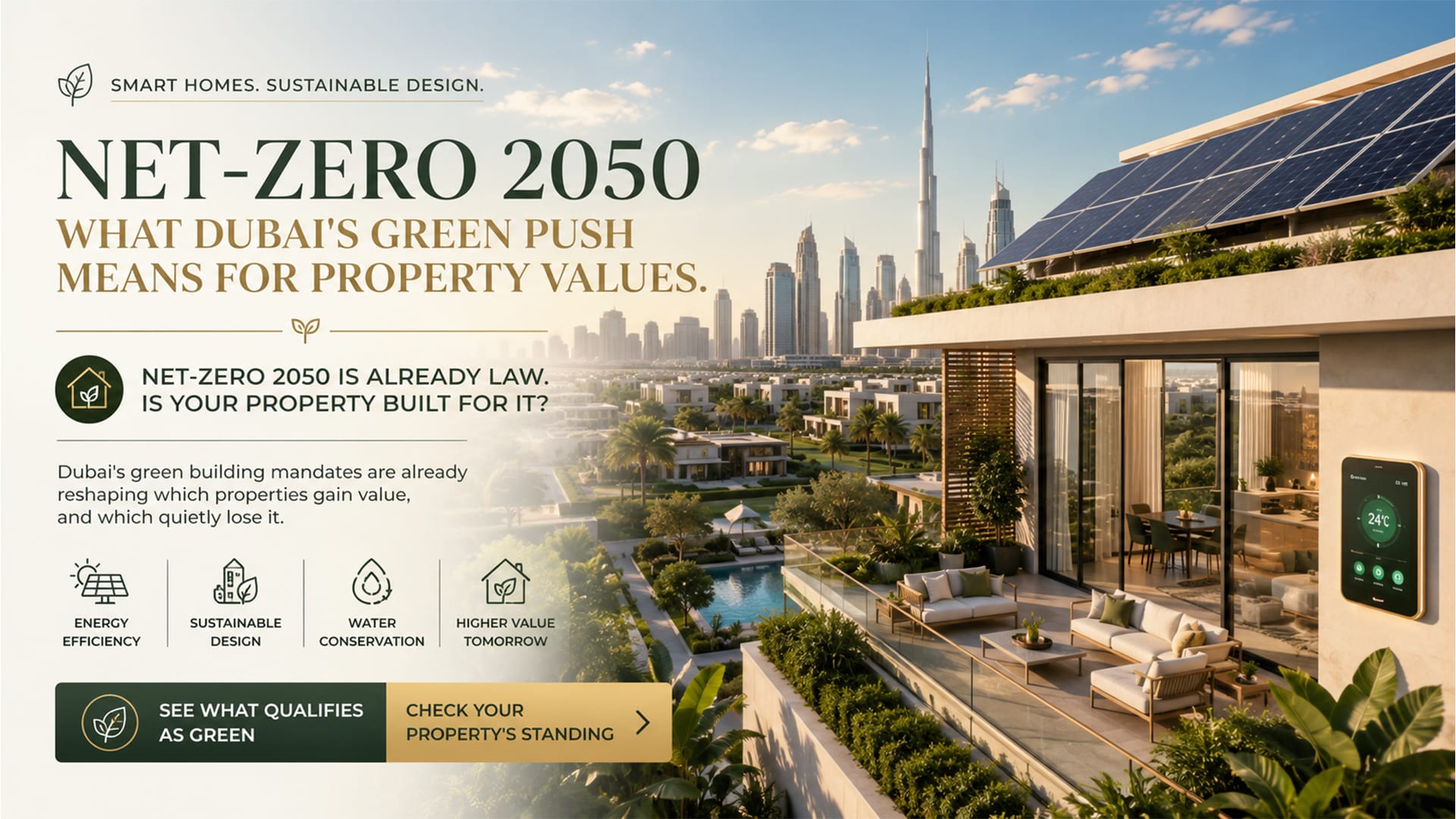
The Net Zero 2050 strategy is not a pledge card. It is a construction code, a certification regime, a retrofit mandate, and a financial incentive structure that is already reshaping which buildings appreciate and which ones quietly accumulate risk. The investors who understand this now are not being idealistic. They are being early.
In Dubai, sustainability is not a lifestyle choice but a regulatory direction, and the property market is already pricing it in.
The Policy Is Not Coming. It Is Already Law.
The UAE became the first country in the Middle East to legislate a national Net Zero target by 2050. Within that framework, Dubai moved fast, faster than most cities in far wealthier countries. Green Building Regulations and Specifications have been mandatory for all new developments since 2014. The Al Sa’fat rating system, Dubai’s proprietary green building classification, now requires every new building to achieve at a minimum a Silver rating. The Dubai Green Building Regulations, updated in 2025, tightened thresholds further, adding mandatory specifications for smart metering, insulation performance, solar readiness, and water reuse across the entire development pipeline.
This is enforced compliance with legal consequences for falling short. Every developer, every contractor, every building permit application is measured against these standards. The result is a market that is structurally splitting into two categories: buildings that are future-proof and buildings that are not.
The financial implication of that split has a name the industry is starting to use openly: the brown discount, the progressive devaluation of properties that fall short of green standards as the regulatory floor rises around them.
The brown discount is real. Buildings that do not meet green standards are already losing ground in yield, occupancy, and resale, quietly but consistently.
The Three Pillars Driving the Green Premium
Regulatory Mandate
Every new build must comply. Non-compliant older stock faces retrofit costs or value erosion, there is no third option.
Financial Incentive
Green mortgages from FAB and ADCB offer preferential rates for certified properties. Lower cost of capital changes the investment maths fundamentally.
Buyer Demand Shift
A 2025 YouGov poll found nine in ten UAE residents now rank a sustainable home as a top priority. Demand is not emerging; it has arrived.
What Smart Homes Actually Deliver, Beyond the Brochure
The phrase smart home has been diluted by overuse. In Dubai’s regulatory context, it means something precise and financially material, not a voice assistant and app-controlled lighting, but an integrated system that fundamentally changes the economics of ownership.
Smart HVAC systems adapt to occupancy and external temperature in real time, reducing cooling costs in a desert climate by a documented margin that compounds across years of ownership. AI-driven energy management learns usage patterns and eliminates waste automatically. Solar photovoltaic panels, now standard in leading communities under the Shams Dubai programme, allow homeowners to feed surplus energy back to DEWA’s smart grid, converting a utility cost into a utility income. Smart water metering with grey-water recycling reduces consumption without any lifestyle adjustment. Predictive maintenance systems identify faults before they become failures, cutting service charge exposure and protecting long-term fabric.
None of these are amenities in the traditional sense. They are financial mechanisms built into the building. Mechanisms that generate measurable savings from the first month of occupation and compound in value as energy costs rise, as tenant expectations shift, and as the regulatory floor beneath non-compliant buildings rises further.
A smart building does not just cost less to run. It is worth more to own, easier to rent, and more resilient to every market cycle it will face between now and 2050.
Green Certification Is the New Pricing Signal
Three certification frameworks now function as market-pricing signals in Dubai: LEED, the globally recognised Leadership in Energy and Environmental Design standard; Al Sa’fat, Dubai Municipality’s own tiered rating system from Bronze to Platinum; and BREEAM, the British-origin framework adopted by major developers including Majid Al Futtaim across their master-planned communities.
These certifications do not simply validate environmental performance. They validate financial performance. A LEED-certified building produces evidence, independently audited and externally verified, that it consumes less, costs less to operate, and retains tenants more consistently than its uncertified equivalent. That evidence translates directly into yield, occupancy rate, and resale demand.
The market has absorbed this logic. Eco-certified communities in Dubai are demonstrating stronger price resilience, lower vacancy, and more consistent buyer demand than comparable uncertified stock. The investors who moved early into The Sustainable City, Tilal Al Ghaf, and Expo City developments have the appreciation figures to prove it. And the pipeline of new certified supply, while growing, has not yet caught up with the structural demand for compliant assets, which means the premium for certified property is not compressing. It is holding.
Green vs. Conventional: The Investment Reality
| Green / Smart Property | Conventional Property |
|---|---|
| Mandatory regulatory compliance, zero retrofit risk | Growing non-compliance exposure as standards tighten |
| Lower service charges via smart energy systems | Rising utility costs with no efficiency offset |
| Premium rental yield, less vacancy, more retention | Yield compression as eco-demand concentrates on certified stock |
| LEED / Al Sa’fat certified, qualifies for ESG capital | Excluded from institutional ESG mandates globally |
| Green mortgage eligible, reduced cost of capital | Standard financing only, higher long-term carry cost |
| Future-proof appreciation trajectory to 2050 | Brown discount risk as the regulatory floor rises around it |
The Communities That Proved the Theory Correct
Abstract arguments about sustainability and value are useful. What is more useful is looking at the communities that tested the thesis in the real market and observing what happened.
The Sustainable City, conceived and built by Diamond Developers as a proof of concept for net-zero community living in a desert climate, is now fully operational, consistently at capacity, and one of the most referenced projects in Dubai’s sustainable development story. It produces as much energy as it consumes. It generates no internal combustion traffic. It has organic farms, clean air monitoring, and a community culture built around environmental stewardship. When it launched, it was called ambitious. Today, it is called oversubscribed, and the waiting lists are the evidence that the market responded to substance, not marketing.
Tilal Al Ghaf by Majid Al Futtaim brought BREEAM certification and Crystal Lagoon technology together in a community designed from its first planning document around walkability, solar power, rainwater harvesting, and eighty percent green coverage. Every phase launch has sold strongly. Investors who entered at launch have seen consistent appreciation.
Expo City Dubai, the permanent legacy of Expo 2020, is being built out as one of the most advanced smart-city ecosystems in the world. Every building is net-zero by specification. The district runs on its own energy management infrastructure. It is less a neighbourhood than a working demonstration of everything Dubai intends its entire built environment to become by 2040. Dubai Hills Estate, under Emaar, carries LEED Gold certification on its residential offerings and has demonstrated that certified luxury and certified sustainability are not competing values; they are the same product.
These are not isolated experiments. They are the market’s direction of travel, replicated at scale, confirmed by demand, and now embedded in the regulatory baseline that every new project must meet.
Communities built on green principles were once exceptions in Dubai’s skyline. They are becoming the standard, and everything else is becoming the exception.
The Investment Logic: Clear, Structural, Verified
The most common objection to green property investment is that sustainability comes at a cost. The 2026 market data says otherwise.
When measured across total cost of ownership, acquisition, service charges, utility costs, maintenance and resale, green-certified buildings in Dubai are outperforming their conventional equivalents across every meaningful metric. Lower service charges because smart systems cut operational costs. Higher net yield because lower vacancy and premium rental demand offset any acquisition premium. Stronger resale because the buyer pool for certified properties is growing, driven by the regulatory mandates that every future buyer will face. And a financing advantage via green mortgages, now offered by FAB, ADCB and other major UAE lenders, that reduces the cost of capital and improves the purchase-to-yield ratio from the outset.
For institutional investors, the logic is even more direct. ESG mandates now govern a significant and growing portion of global real estate capital. Portfolios must demonstrate environmental credentials to attract international funding, attract certain tenants, and comply with the reporting standards of major markets. Dubai’s green-certified stock is increasingly the only Dubai stock that qualifies for this capital, which means its demand profile is structurally different from the rest of the market, and its pricing reflects that.
- Al Sa’fat-compliant buildings deliver documented energy savings that flow directly to net yield, cutting service charge exposure and improving cash-on-cash returns.
- District cooling systems, now standard across master-planned communities, are significantly more efficient than individual HVAC units, reducing the single largest cost of desert-climate ownership.
- The Shams Dubai programme allows solar-equipped homeowners to feed surplus energy back to DEWA’s smart grid, turning a cost centre into an income line.
- Green retrofit value-add strategies are emerging in prime areas like Jumeirah and Emirates Hills: purchasing older inefficient stock, upgrading to compliance, and realising returns that outperform standard renovation.
- Sustainable properties above the qualifying investment threshold carry full UAE Golden Visa eligibility, adding a long-term residency dimension to what is already a strong financial case.
The Green Premium Is Not a Trend But a Trajectory
Dubai does not make commitments it does not intend to keep. The Net Zero 2050 strategy is backed by legislation, enforced through building codes, resourced through government programmes, and reflected in the prices buyers are willing to pay right now in 2026 for properties that meet the standard.
The window in which green property represents an early-mover advantage is narrowing. Not because the market is slowing, it is not. But because regulatory pressure is catching up with conventional stock from below, and institutional demand is driving up certified stock from above. The middle ground, the uncertified, unrenovated, unthinking purchase, is where the risk is accumulating quietly.
The conversation worth having is not whether to include sustainable property in your Dubai portfolio. It is where, at what certification level, through which developer, and with what financing structure you do it most effectively.
That conversation belongs with an advisor who understands both the market and the mandate. It starts with a single question: is the property you are considering built for the Dubai of 2050, or just for today?
In every great city’s history, there is a moment when tomorrow’s standard becomes today’s baseline. In Dubai, that moment for sustainable property is now.