



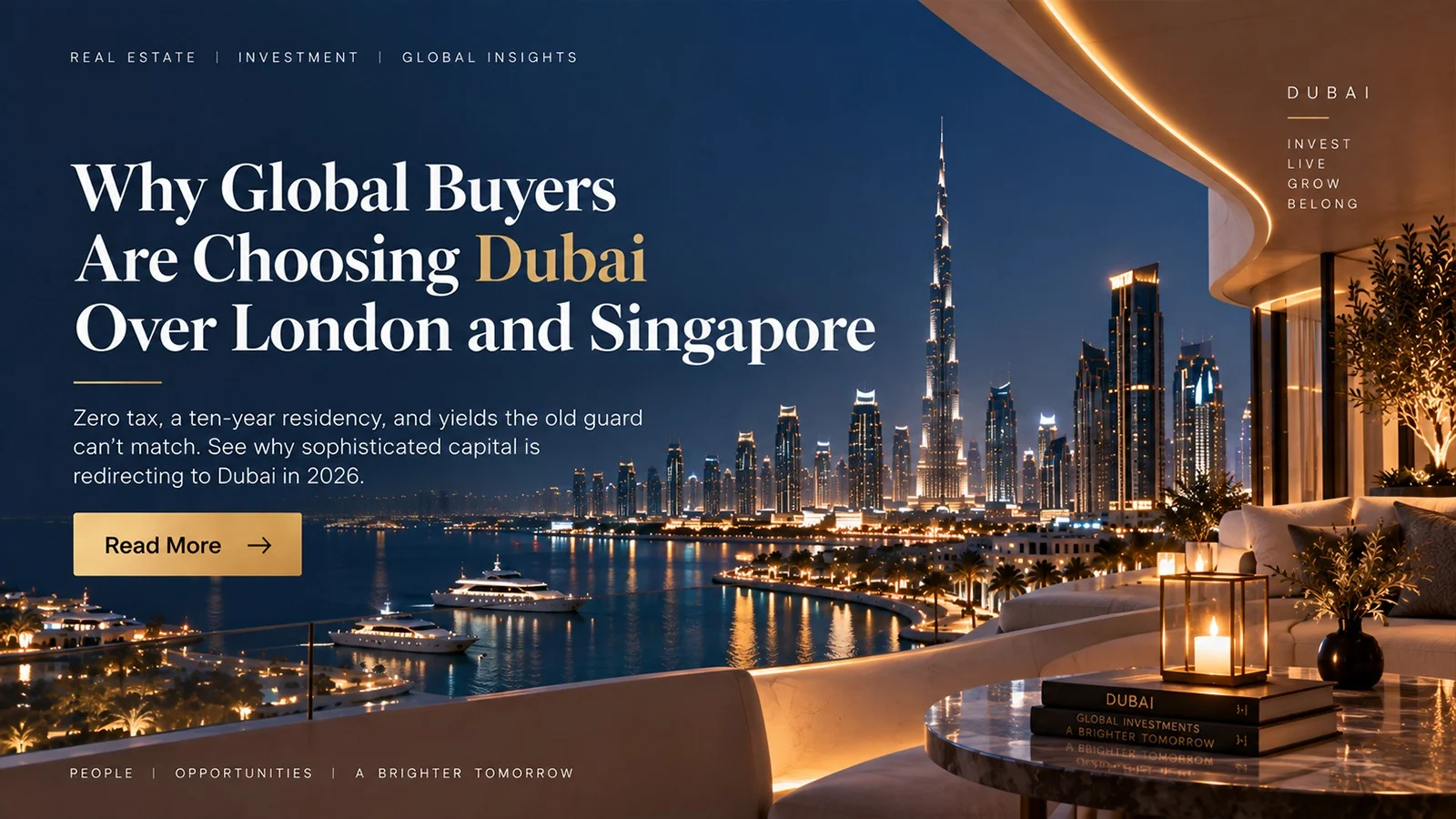
There was a time when the global property conversation began and ended with London and Singapore. That time has passed.
Not because those cities have fallen. They remain powerful, prestigious, and deeply liquid markets. But something more interesting is happening. The world's most sophisticated investors, the ones who move deliberately, who measure everything, and who built wealth precisely because they do not follow consensus, are redirecting capital. The destination is Dubai.
This is not a trend. It is a structural shift. And understanding why it is happening tells you far more about where global real estate is heading than any single market report ever could.
The Rules Changed. Dubai Noticed. London and Singapore Didn't.
The most important thing that has happened in global property investment over the past few years is not a price move. It is a policy divergence.
London answered the era of global wealth mobility with taxes. Stamp duty surcharges for overseas buyers. Capital gains obligations for non-residents. Income tax on rental earnings that strips yield before it reaches your account. A system designed, whether intentionally or not, to extract value from international capital rather than welcome it.
Singapore went further. Its Additional Buyer's Stamp Duty for foreign purchasers has climbed to a level that has made international investment in the city-state, for most buyers, mathematically difficult to justify. The signal is clear: Singapore's property market is being reserved, firmly and deliberately, for its citizens.
Dubai read the same global moment and responded with the opposite instinct. It opened. It simplified. It created a freehold framework, extended it into new communities, built a residency pathway directly through property ownership, and kept the tax environment at zero, on income, on capital gains, and on annual property holding. No surcharges for being foreign. No penalty for investing from abroad.
When two cities close their doors, and one throws them open, capital flows are not subtle.
What "Zero Tax" Actually Means at Scale
It is easy to read "no property tax" as a headline and move on. But the compounding reality of a zero-tax holding environment over a serious investment horizon is staggering.
In London, a high-value property generates rental income subject to income tax, a capital gain at sale subject to CGT, and during the hold - stamp duty paid on entry that starts high for non-residents and climbs from there. The net return, on a prime London asset held for a decade, is a fraction of the gross yield. The city delivers prestige. The financial mathematics delivers something considerably more modest.
In Dubai, the gross yield and the net yield are the same conversation. What the property earns, the investor keeps. What the property appreciates, the investor captures in full. This is not a minor advantage. Across a multi-property portfolio held over years, it is the difference between wealth preservation and wealth creation.
The elite investor understands this intuitively. The newer investor learns it the moment they model both scenarios side by side.
The Residency Equation That Changes Everything
Property in London is property. Property in Singapore, for a foreign national, is an expensive, heavily taxed asset in a market that has structured itself to discourage them.
Property in Dubai is a key.
The UAE's Golden Visa programme, permanently linked to qualifying property ownership, offers a ten-year renewable residency that has no parallel among the world's tier-one cities. Renew it indefinitely. Sponsor your family. Maintain it even if you spend most of your time elsewhere. It is residency designed for the globally mobile, not as a bureaucratic hurdle, but as a genuine anchor point in one of the world's best-positioned cities.
For the business owner who wants a UAE base. For the family that wants an education hub with international schools, safety, and sun. For the wealth manager looking to optimise where clients hold residency in relation to where they hold assets. The Golden Visa through Dubai property ownership is not a perk. For many buyers, it is the primary strategic reason for the transaction.
London and Singapore offer no equivalent. Owning property there gives you an asset. Dubai gives you an asset and a second home, simultaneously.
The Yield Gap That Has Become Impossible to Ignore
Rental yields are where the comparison between these three cities becomes most stark and most decisive for the income-focused investor.
London's prime residential yields have compressed to a level where, net of tax and management, they represent marginal income at best. The asset class functions as capital preservation, not cash flow. Singapore's yield profile tells a similar story, restrained by high entry prices, cooling measures, and a market that prioritises stability over return.
Dubai's rental yields consistently outperform both cities across virtually every asset class and community tier. From the lifestyle districts of Dubai Marina and Downtown to the family-oriented corridors of Dubai Hills and Creek Harbour, the income generated relative to the purchase price reflects a market that is still maturing. Here, demand is outpacing supply, population growth is adding genuine occupier pressure, and the short-term rental ecosystem runs alongside long-term leasing as a legitimate yield strategy.
For the investor whose capital needs to work, not merely exist, the yield gap between Dubai and its two closest global comparators is not a nuance. It is the conversation.
Space, Scale, and What Your Budget Actually Buys
There is a dimension to this comparison that spreadsheets do not fully capture, but buyers feel immediately.
What a serious property budget buys in London is a well-located flat in a competitive postcode, with service charges, a leasehold clock ticking in the background, and the perennial British relationship with grey skies and rising damp. What the same budget buys in Dubai is a full-floor apartment with a direct Burj Khalifa view, or a villa with a private pool, or a waterfront residence in a masterplanned community with amenities that London's prime zones cannot match.
Singapore, with its land constraints and population density, compresses space in a way that makes comparable living standards require significantly higher spend.
Dubai offers scale. It offers newness. It offers architecture and infrastructure that feels aspirational rather than aging. For buyers who have spent their lives in older global cities and are considering where to invest, hold, or relocate, the lived experience of what their money buys is not a minor consideration. It is often the deciding one.
The Currency Advantage Quietly Reshaping Portfolios
The AED's peg to the US dollar is a structural feature of Dubai investment that deserves more attention than it typically receives in the headline comparison.
London property is denominated in sterling, a currency that has experienced significant volatility in recent years and that carries political and macroeconomic risk that is entirely outside the investor's control. Singapore property is SGD-denominated, with its own currency dynamics.
Dubai property, priced in AED and backed by the USD peg, offers an asset class that behaves, from a currency perspective, like a dollar investment. For investors from India, Europe, Asia, or the Americas who are already managing significant USD exposure in their portfolios or who simply want stability in the currency underpinning their real estate, this is a meaningful structural advantage that compounds silently over a hold period.
Why This Is Not a Temporary Moment
The sceptic's response to Dubai's rising prominence in global real estate conversations is always some version of: "Dubai is cyclical. We've seen this before."
It is a reasonable caution. Dubai's market has moved through cycles. The correction from the mid-2010s to 2020 was real, and investors who experienced it carry legitimate institutional memory.
But 2026 Dubai is structurally different from 2008 Dubai or 2014 Dubai. Regulatory infrastructure is substantially stronger - escrow protection for off-plan buyers, RERA oversight, DLD transparency, and digital transaction systems that have reduced the opacity that historically created risk. The buyer base is more diverse, more international, and more driven by end-use and residency motivation than by short-term speculative flipping. The population growth underpinning demand is policy-driven, sustained, and deliberately managed as part of Dubai's D33 economic agenda.
And crucially: the policies that have made Dubai compelling to international buyers, the freehold framework, the Golden Visa, the zero-tax environment, are not temporary incentives scheduled for review. They are the architecture of a city that has decided, at the highest levels of government, what it wants to be on the world stage.
London is not going to remove its foreign buyer surcharges. Singapore is not going to reverse its Additional Buyer's Stamp Duty. And Dubai is not going to start taxing the international capital that is actively building its next decade.
The divergence is structural. And it is not correcting.
The Real Question for the International Buyer in 2026
This is not a blog that argues London and Singapore do not have merit. For a specific investor profile, one optimising for ultra-long-term capital preservation, deep liquidity, and legacy positioning in established Western legal frameworks, London retains a genuine argument.
But for the investor who wants yield, residency, growth, space, and the ability to keep what they earn, the comparison, in 2026, is no longer particularly close.
The world's most mobile, most informed, and most commercially sophisticated buyers are not choosing Dubai because they have been sold something. They are choosing Dubai because when they model the alternatives honestly, the conclusion becomes difficult to avoid.
The shift is real. The window, as always in emerging market cycles, will not stay this wide forever.
Ready to explore what Dubai's property market can do for your portfolio? Talk to a USH advisor and make the comparison with full information behind you.
Dubai D33 & Real Estate: What the $8.7 Trillion Economic Agenda Means for Property Investors