
The short answer
- Foreign buyers can own commercial property in Dubai's freehold areas.
- Commercial leases on the mainland must be registered in Ejari.
- Commercial rent, and most commercial property sales, carry 5% VAT.
- When you buy, you pay a 4% Dubai Land Department transfer fee, plus other fees.
- Mainland commercial leases fall under Law No. 26 of 2007, the same law as homes, with a few important differences.
Market snapshot: Q3 2026
- Offices
- Average rent about AED 241 per sq ft a year, stable in the quarter (Savills, 15 October 2026). Occupancy about 95% (CBRE, 3 November 2026).
- Warehouses
- Rents up 5.9% on a year earlier to about AED 50 per sq ft, with warehouses close to full (JLL, reported 11 November 2026).
- Retail
- High occupancy and rising rents in prime locations (CBRE, Q3 2026). Updated every quarter.
Part 01
Types of commercial property in Dubai

Commercial property is any space used for business rather than as a home. The type you choose affects the rent, the fit-out work and the licence you need.
Offices. The largest part of the market. Offices are leased or sold either as shell and core, which means a bare space with basic services where you build the interior yourself, or fitted, which means walls, ceilings, lighting and sometimes furniture are already in place. Shell and core costs less in rent but more in fit-out; fitted offices let you move in sooner.
Retail shops and showrooms. Ground-floor units in residential and office towers, shops in malls and community centres, and larger showrooms on main roads. Footfall, visibility and parking matter most.
Warehouses and industrial units. Used for storage, logistics and light manufacturing, mainly in areas such as Al Quoz, Dubai Investments Park and Jebel Ali. Demand has been strong in 2026, and good units are hard to find.
Whole buildings and mixed-use. Some investors buy a full building or a floor in a mixed-use tower. These purchases need more detailed checks and usually specialist advice.
Mainland or free zone?
Where your business is licensed decides where you can lease, which rules apply and who registers your lease.
| Mainland | Free zone (for example DMCC, DIFC, JAFZA) | |
|---|---|---|
| Who licenses your business | Dubai's Department of Economy and Tourism (DET) | The free zone authority |
| Lease registration | Ejari | The free zone's own system |
| Which leasing rules apply | Law No. 26 of 2007 | The free zone's own rules (DIFC has its own Leasing Law) |
| Where you can trade | Across the UAE market | Mainly within the free zone and abroad; rules vary |
Before you sign anything, check that the space you want is allowed for your business activity and matches your licence type.
Part 02
Should you buy or lease commercial property?
Most businesses lease, especially in their first years in Dubai. Buying makes more sense when you have a long-term plan for the space, or when you are investing and want rental income.
| Lease | Buy | |
|---|---|---|
| Upfront cost | Rent, deposit, agency fee, Ejari | Price, 4% DLD fee, VAT where it applies, agency fee |
| Flexibility | Easier to move or grow | Harder to move; selling takes time |
| Control over the space | Limited by the lease and landlord | Full control, within building rules |
| Running costs | Rent plus VAT; service charges are often included | Service charges, maintenance and any loan payments |
| Best for | New or growing businesses | Established businesses, or investors with a long-term plan |
If you're leasing, read the next section. If you're buying, skip to Buying commercial property in Dubai.
Part 03
Leasing commercial property in Dubai, step by step

Renting commercial property in Dubai takes more planning than renting a home, mainly because the space has to suit your licence and you may need approvals before you can use it.
- Check your licence and activity. Make sure the unit's permitted use matches your business activity and your licence, mainland or free zone.
- Set your budget and size. Include 5% VAT on rent, fit-out costs and service charges, not just the headline rent.
- Search and view. Work with an agent licensed by the Real Estate Regulatory Agency (RERA), and see a few options before deciding. Our current offices for rent are a good place to see what's available.
- Make an offer and agree the main terms. Rent, lease length, any rent-free period and the number of cheques.
- Review the lease. See the checklist below.
- Pay the deposit and rent cheques. A security deposit is usually required.
- Register the lease in Ejari (mainland). An Ejari-registered lease is normally needed to issue or renew your trade licence.
- Get fit-out approvals. Building management or the master developer must approve your plans, and some work also needs Dubai Municipality and Dubai Civil Defence approval.
- Move in.
Commercial lease terms to check
A commercial lease is a business contract, and most of it can be negotiated. Check these points before you sign:
- Rent and increases: how much, and how increases at renewal are worked out.
- Lease length: usually one to five years, sometimes longer for larger spaces.
- Payment schedule: how many cheques a year.
- Rent-free fit-out period: often one to three months for unfitted space.
- Service charges: included in the rent or charged separately.
- Break clause: whether, and when, you can leave early.
- Renewal terms: your right to renew and the notice needed.
- Reinstatement: whether you must return the unit to its original condition when you leave, and who pays.
- Permitted use: what you're allowed to do in the space.
Your rights as a commercial tenant
On the Dubai mainland, commercial leases are covered by Law No. 26 of 2007, amended by Law No. 33 of 2008. The main points:
- Rent increases are capped. At renewal, a landlord can only raise the rent within the limits set by Decree No. 43 of 2013, which allows from 0% to 20% depending on how far your rent is below the market rate.
- Changes need 90 days' notice. Either side must give 90 days' notice before the lease ends to change its terms.
- No early ending by the landlord. A landlord can't end the lease early on their own.
- Eviction needs 12 months' notice. If the landlord wants the unit back to use it, sell it or carry out major works, they must give 12 months' notice by notary or registered mail, taking effect at the end of the lease.
- A 3-year re-letting ban. If a landlord evicts you to use the space themselves, they can't rent it to someone else for 3 years. For homes, it's 2 years.
- Don't leave it empty. Leaving commercial premises unused for 30 days without a valid reason can be grounds for eviction.
- A sale doesn't end your lease. If the building is sold, your lease continues with the new owner.
- Disputes go to the Rental Dispute Centre.
If your business is in a free zone, its own rules may apply instead. For example, DIFC has its own Leasing Law. For the rules on renting a home, see our guide to tenant rights in Dubai.
Leasing costs: a worked example
Here's how the first-year cost works for a 1,000 sq ft office at AED 241 per sq ft, the Q3 2026 average reported by Savills. Rents vary widely by building and area, so treat this as a method, not a quote.
| Item | AED |
|---|---|
| Annual rent (1,000 sq ft × AED 241) | 241,000 |
| VAT on rent (5%) | 12,050 |
| Rent plus VAT for year one | 253,050 |
Add the deposit, agency fee, Ejari fee and any fit-out cost to reach your full first-year budget.
Part 04
Buying commercial property in Dubai, step by step

Foreign buyers can own commercial property in Dubai's designated freehold areas under Law No. 7 of 2006, just as they can with homes. You can buy in your own name or, in some cases, through a company. Whether a company can hold the title depends on the company type and the area, so take legal advice before you decide how to own it. For many investors, commercial property investment in Dubai means buying a unit that already has a tenant in place.
- Check the area and building. Confirm the building is in a freehold area and that its permitted use suits your plans.
- Do your checks. Look at the title deed, any mortgage on the unit, the service charges listed in Mollak (the Dubai Land Department's service charge system), the current tenant and lease, and the condition of the building.
- Agree the price and sign Form F. Form F, also called the MoU, is the standard sale agreement. A 10% deposit is usual.
- The seller gets a No Objection Certificate (NOC) from the developer, confirming service charges are paid.
- Pay VAT if it applies. See the section below.
- Transfer at a Registration Trustee office. You pay the 4% Dubai Land Department (DLD) fee, and the title deed is issued in your name.
- Take over any tenant. If the unit is leased, the lease continues with you as the new landlord.
You can see the commercial property for sale in Dubai that we're currently handling on our listings page.
VAT when you buy commercial property
This is the biggest difference from buying a home. The resale of a home is exempt from VAT, but the sale of commercial property is generally subject to 5% VAT.
When the seller isn't the developer, you as the buyer may need to pay the VAT on commercial property directly to the Federal Tax Authority (FTA) before the transfer. You'll need the seller's Tax Registration Number (TRN), and you show the payment reference at the trustee office on transfer day.
If your business is registered for VAT and uses the property for taxable business, you can usually recover this VAT. If you then rent the property out and the rent is more than AED 375,000 a year, you must register for VAT yourself; you can choose to register from AED 187,500.
There are exceptions, such as when a whole business is sold as a going concern, so take tax advice before you agree the price.
Buying costs: a worked example
An AED 2,000,000 office, bought with cash from a seller who isn't the developer:
| Item | AED |
|---|---|
| DLD transfer fee (4%) | 80,000 |
| VAT on the price (5%), if it applies | 100,000 |
| Registration trustee fee (AED 4,000 + 5% VAT) | 4,200 |
| Title deed fee | 580 |
| Agency fee (2% + 5% VAT) | 42,000 |
| Total on top of the price, including VAT | 226,780 |
| Total on top of the price, without VAT | 126,780 |
A VAT-registered business may be able to recover the AED 100,000 VAT; an individual usually can't. You will also pay yearly service charges. Work out your costs with our calculator.
Financing a commercial purchase
Commercial loans aren't covered by the Central Bank's limits for home loans. Lenders may finance about 50–75% of the value, usually over 5 to 15 years, at higher rates than home loans. They look closely at the business's accounts and at the property's rental income.
Expect to provide your trade licence, audited accounts, bank statements and any tenancy contracts. Borrowing costs also follow interest rates: the UAE Central Bank's base rate has been 3.90% since 17 September 2026.
Tax on rent from commercial property
Commercial rent carries 5% VAT, and landlords whose rent is above AED 375,000 a year must register for VAT.
For income tax, individuals who earn rent from property in their own name, without needing a business licence, are generally outside UAE corporate tax under Ministerial Decision No. 49 of 2023. Companies that own property pay corporate tax under the normal rules, at 9% on taxable profit above AED 375,000. If you live abroad, your home country may also tax the rent. Take tax advice before you buy.
Part 05
Popular areas for commercial property
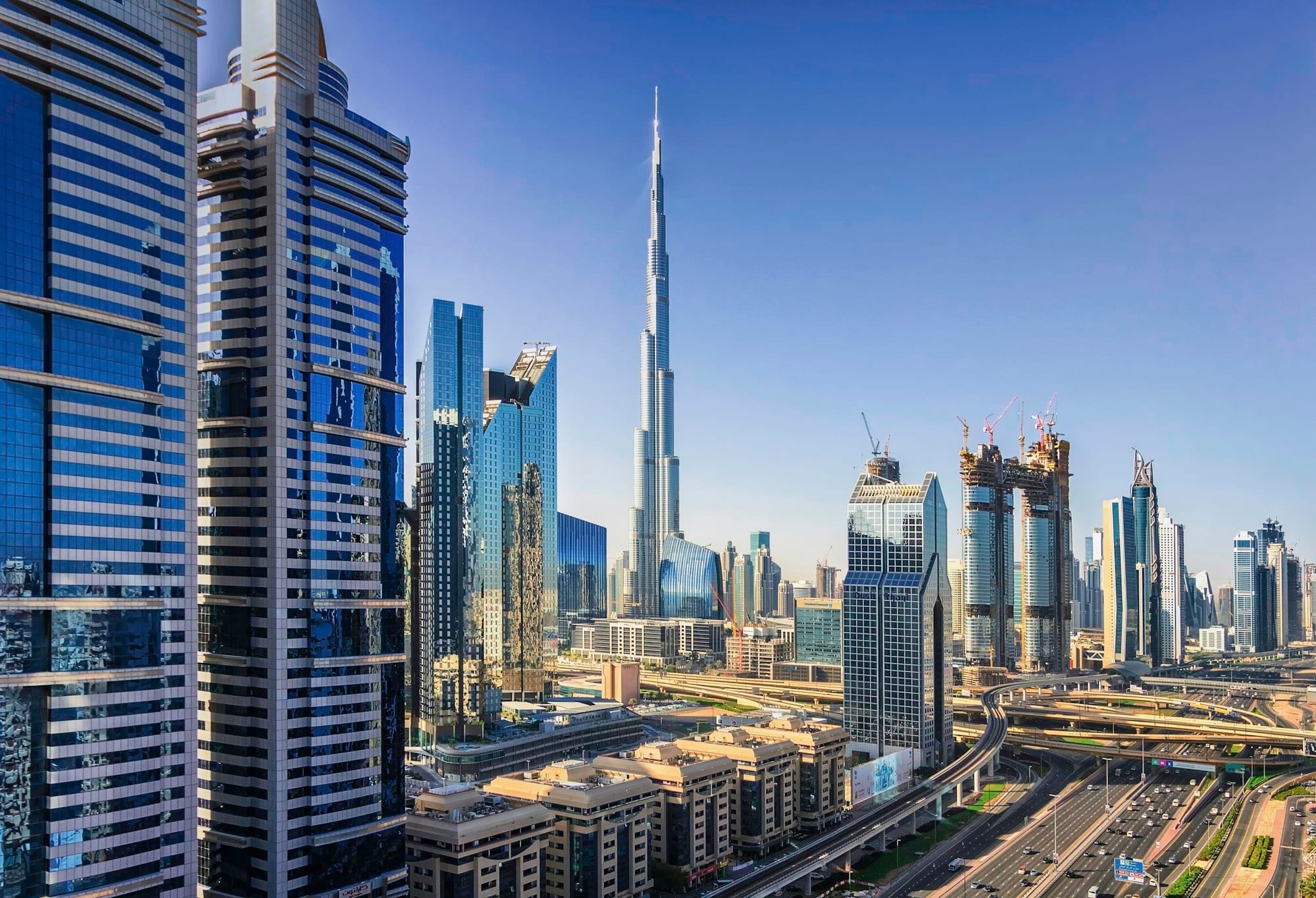
Business Bay. A mainland business district next to Downtown, with a wide choice of office towers in Business Bay across different price ranges.
Jumeirah Lake Towers (JLT). A mix of DMCC free zone and mainland towers, which makes JLT popular with small and mid-sized firms.
DIFC. Dubai's financial free zone, with its own laws and courts, and premium offices for finance and professional firms.
Downtown Dubai. Prime offices and retail around Downtown Dubai, close to Burj Khalifa and Dubai Mall.
Barsha Heights. Mid-priced office towers near Sheikh Zayed Road and the metro.
Al Quoz and Dubai Investments Park. Warehouses, showrooms and light industrial units, with good road links.
Jebel Ali and JAFZA. Logistics and warehousing close to Jebel Ali Port, including the Jebel Ali Free Zone.
Part 06
Mistakes to avoid
- Signing a lease before checking the unit is allowed for your licence and business activity.
- Leaving 5% VAT out of your budget.
- Not asking whether service charges are included in the rent.
- Forgetting reinstatement costs when you move out.
- Starting fit-out work before you have approvals.
- Buying a tenanted unit without checking the tenant's lease and payment history.
- Assuming a commercial loan works like a home loan.