

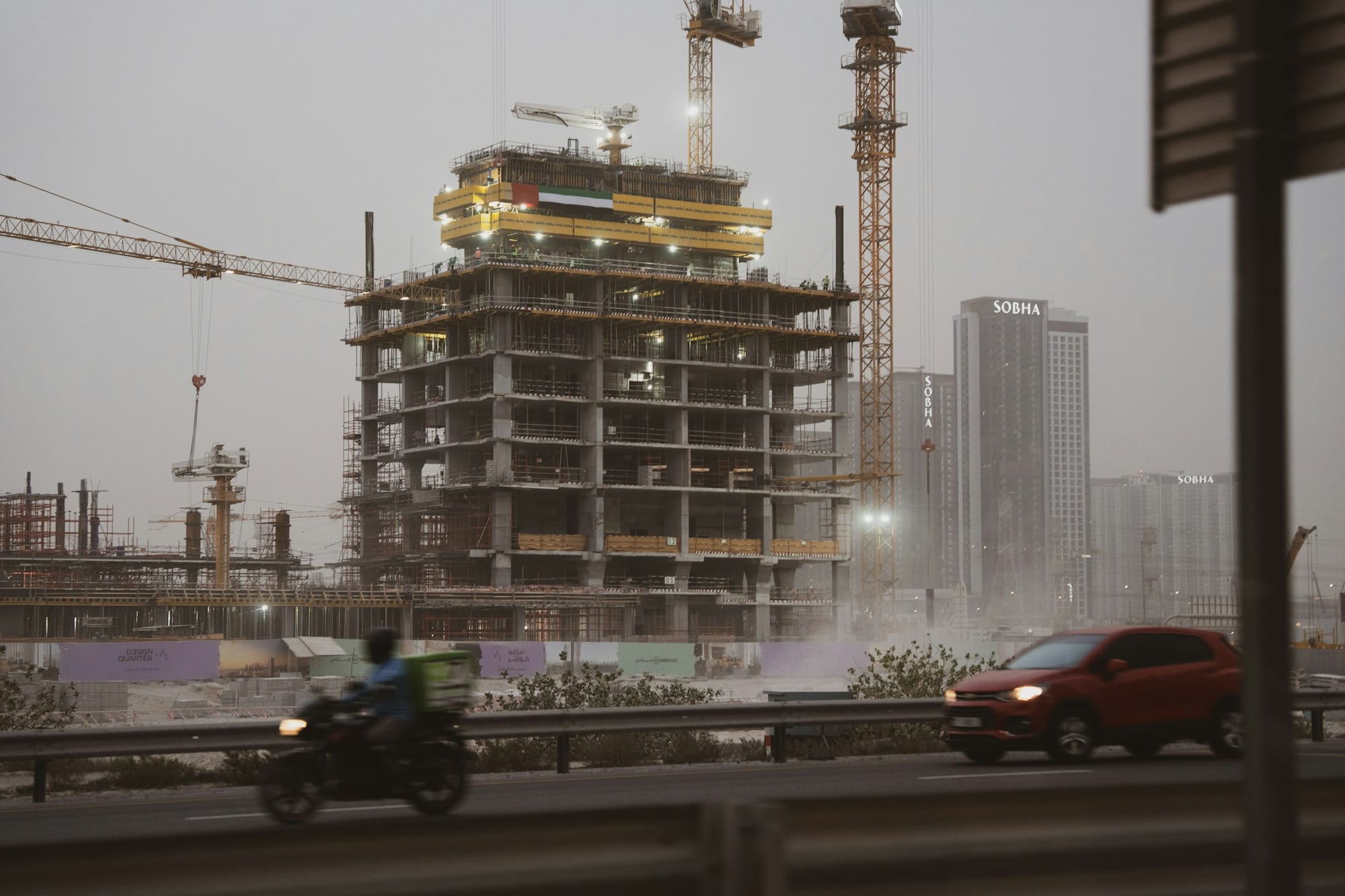
This guide explains how off-plan buying really works in Dubai. It covers how your money is protected, how payment plans are structured, what the full cost is, how to judge a developer, what happens if a project is delayed or you cannot pay, how to sell before completion and what to expect at handover. It is written for first-time and overseas investors, and for anyone who plans to live in the home once it is finished.
The legal points come from Dubai's escrow law (Law No. 8 of 2007), the interim real estate register law (Law No. 13 of 2008, as amended by Law No. 19 of 2017) and the UAE Central Bank's mortgage rules. The practical advice comes from our off-plan team, who work with Dubai's developers and buyers every day.
Quick answer: how does buying off-plan property in Dubai work?
You buy a home from a developer before it is built or finished. You pay a booking amount, usually 10–20% of the price, plus the 4% Dubai Land Department (DLD) registration fee, and then pay the rest in instalments during construction, at handover or sometimes after it. Your payments go into a DLD-regulated escrow account for that project, and your purchase is recorded in the DLD's interim register, known as Oqood. When the building is complete, you pay any balance due, receive the keys and get your title deed. Before paying anything, check that the developer and project are registered with the DLD.
Part 01
What off-plan property means in Dubai

Off-plan property is a home you buy from a developer before construction is finished, and sometimes before it has started. You choose your unit from floor plans, brochures and a show apartment, agree the price and payment schedule, and the developer builds it over the following months or years.
There are two ways to buy off-plan. The first is buying directly from the developer at launch or during construction, often called the primary market. The second is buying from another investor who bought earlier and is selling their contract before handover, often called an off-plan resale or assignment. The protections and process are similar, but the price, payment terms and fees can be different, so it is important to know which one you are looking at.
Foreign buyers can purchase freehold property, including off-plan, in Dubai's designated freehold areas, and you do not need to live in the UAE to buy.
Part 02
Off-plan or ready: which suits you?
Neither option is better for everyone. The right choice depends on when you need the home, how you want to pay and how much uncertainty you are comfortable with.
| Off-plan | Ready property | |
|---|---|---|
| Paying for it | Booking amount, then instalments during construction and sometimes after handover | Full price at transfer, usually with a mortgage |
| Mortgage | Up to 50% of the value, and only from banks that lend on that project | Up to 80% for a first home under AED 5 million (expatriates) |
| Moving in or renting out | Only after completion, which can be years away | Straight away |
| What you see before buying | Plans, brochures and a show unit | The actual home, building and neighbours |
| Choice | Wide choice of units and floors at launch | Limited to what is on the market |
| Condition | Brand new, with a developer warranty | Depends on age and upkeep |
| Main risks | Delays, changes to the market by handover, a smaller pool of resale buyers before completion | Higher upfront cash, older buildings may need more maintenance |
Off-plan tends to suit buyers who do not need the home immediately, who prefer to spread payments over time and who are buying for the medium to long term. A ready property tends to suit buyers who need to move in or earn rent straight away, or who want to see exactly what they are buying. Our article on off-plan vs ready property compares the two in more depth.
Part 03
How Dubai protects off-plan buyers

Dubai's off-plan rules date back to 2007 and 2008 and have been tightened since. They are the main reason buyers today can pay for a home that does not exist yet with reasonable confidence. These protections do not remove every risk, but they do make sure your money is tied to a real, approved project.
Project registration
A developer cannot sell off-plan units in Dubai until it owns or controls the land, has the regulatory approvals and has registered the project with the Dubai Land Department and its regulator, RERA. Sales contracts for projects that have not been approved are treated as invalid. Every advertisement for the project also needs a DLD permit.
Escrow accounts
Under Law No. 8 of 2007, every off-plan project must have its own escrow account with an approved bank. Your payments for the unit go into that account, not to the developer's general business account. The developer can only draw money from it in line with construction progress, which is checked and certified. This means your money is used to build your project, not someone else's. Always pay into the escrow account named in your contract, and never into a personal account or by an informal transfer.
Oqood: the interim register
Because there is no finished property to put on a title deed yet, off-plan purchases are recorded in the DLD's interim real estate register, set up under Law No. 13 of 2008. This registration is called Oqood. It records you as the buyer of that specific unit and protects you from the unit being sold twice. You pay the 4% DLD registration fee at this stage, and the Oqood certificate is issued to you digitally and shown in your profile on the Dubai REST app. When the building is complete, the Oqood registration is converted into a full title deed.
How to check a project yourself
You do not have to rely on the sales brochure. Before you pay a booking amount:
- Download the Dubai REST app, the DLD's official app, or use the DLD website.
- Search for the developer and confirm it is registered.
- Search for the project and check that it is registered, its status and its current completion percentage.
- Check the escrow account details shown for the project and compare them with the account named in your reservation form or contract.
- Check the advertised completion date against the one in the official record.
If anything does not match, stop and ask questions before you pay.
What these protections do not cover
The rules protect your money and your ownership, but they cannot guarantee everything. They do not stop a project being delayed. They do not guarantee that the finish will look exactly like the show apartment. And they do not protect you from market changes: the value of the home at handover may be higher or lower than what you paid. These are the risks you manage by choosing the developer, the project and the contract carefully, which we cover below.
Part 04
How to buy off-plan property in Dubai, step by step
 Step 01 of 08
Step 1: Be clear on your goal and your budget
Start with why you are buying. A home you plan to live in, a unit to rent out and a unit you hope to sell before completion each point to different projects, sizes and payment plans. Then work out the full budget, not just the booking amount. Add the 4% DLD fee, every instalment until handover, any balance due at or after handover, and the costs that start once you own the finished home, such as service charges and furnishing. If you will need a mortgage for part of the price, check what you can borrow early, because off-plan lending is more limited.
 Step 02 of 08
Step 2: Choose the developer and the project
This is the most important decision you will make. A good project from a reliable developer can protect you from most of the problems buyers worry about. Look at what the developer has already delivered: were their recent buildings finished on time, how do they look a few years later, and how do resale prices in those buildings compare with the original launch prices? Then look at the project itself: location, access, what is planned around it, and how many other homes will be completed nearby at the same time. Our section on how to judge a developer gives a full checklist.
 Step 03 of 08
Step 3: Choose the unit
Within a good project, some units are clearly better than others. Think about the view and whether it could be blocked by future buildings, the floor, which way the home faces (sun exposure affects cooling costs), the layout and how usable the space is, and noise from roads or facilities. If you plan to rent the unit out, choose the layouts and sizes that tenants in that area look for, not just the cheapest unit.
 Step 04 of 08
Step 4: Reserve the unit
To hold a unit, you normally sign a reservation form and pay a booking amount, often 10–20% of the price, depending on the developer. At popular launches, some developers first take an expression of interest (EOI) payment to place you in the queue. Before you pay anything, ask whether the payment is refundable, under what conditions and how long the reservation is held. Pay only into the account named in the developer's official documents.
 Step 05 of 08
Step 5: Sign the sale and purchase agreement (SPA)
The SPA is the contract between you and the developer. Read it in full, and take independent legal advice if anything is unclear. Pay particular attention to:
- The anticipated completion date and any grace period the developer has for delays
- What happens, and what compensation applies, if completion is late
- The payment schedule and what triggers each instalment
- The specification of finishes and appliances, and whether the developer can change them
- Late payment penalties
- The conditions for selling the unit before handover
- How and when service charges will start
 Step 06 of 08
Step 6: Register with the DLD (Oqood)
Once the SPA is signed, the purchase is registered with the DLD in the interim register, known as Oqood, and the 4% DLD registration fee is paid, along with DLD administration fees. Some developers cover part or all of this fee as a sales incentive. Keep the Oqood certificate safe; it is your proof of ownership until the title deed is issued.
 Step 07 of 08
Step 7: Pay your instalments and track progress
Pay each instalment on time and only into the project's escrow account. Keep every receipt. Use the Dubai REST app to follow the project's completion percentage, rather than relying only on the developer's updates. If construction seems to stall, ask the developer for an explanation in writing.
 Step 08 of 08
Step 8: Handover
When the building is complete, the developer sends a completion notice and asks for any balance due at handover. You inspect the home, report snags, collect your keys and receive your title deed. We explain this in more detail in the handover section below.
Part 05
Off-plan payment plans explained
Payment plans are one of the main reasons people buy off-plan. Instead of paying the full price at once, you pay in stages. Plans are usually described by percentages, such as 20/80, 60/40 or 50/50, where the first number is the share paid before handover and the second is the share paid at or after handover. The details vary a lot between developers and projects, so always read the actual schedule in the contract.
Construction-linked plans
In a construction-linked plan, instalments are due when the building reaches set stages, such as completion of the foundations, the structure or a certain percentage of the build. If construction moves quickly, payments come sooner; if it slows, they are spread out further. The balance is usually due at handover.
Time-based and monthly plans
Some developers set instalments by date instead, for example every three or six months, or a fixed amount each month. This makes budgeting easier, but your payments continue on schedule even if construction falls behind.
Post-handover plans
With a post-handover plan, part of the price is paid after you receive the keys, in instalments over an agreed period that can run for several years. This can help investors who plan to rent the unit, because rent can help cover the later payments. The trade-off is that you are still paying the developer after completion, and you may not be able to sell or remortgage freely until the plan is cleared. Developers may also price units on long post-handover plans higher, so compare the total price, not just the monthly amount.
An example
The table below compares two common plan types on the same illustrative unit priced at AED 1,500,000. The figures are for illustration only; real plans differ by project.
| Stage | Plan A: construction-linked (20/40/40) | Plan B: post-handover (10/50/40) |
|---|---|---|
| On booking | 20%: AED 300,000 | 10%: AED 150,000 |
| DLD registration (4%) | AED 60,000 | AED 60,000 |
| During construction | 40% in instalments: AED 600,000 | 50% in instalments: AED 750,000 |
| At handover | 40%: AED 600,000 | – |
| After handover | – | 40% over 2 years: AED 600,000 (AED 25,000 a month for 24 months) |
| Paid by handover | AED 1,560,000 | AED 960,000 |
In Plan A, a large payment falls due at handover. Many buyers use a mortgage for this, so speak to a bank early to check what they will lend on the completed home. In Plan B, less is needed by handover, but you have two more years of instalments to cover from your income or the rent.
Reading the small print
Before you sign, check exactly what triggers each payment, how much notice the developer gives, what late payment penalties apply and whether the post-handover instalments are secured against the property. A plan that looks easy on a brochure can be demanding in practice if several large instalments fall close together.
Part 06
The full cost of buying off-plan
The price on the brochure is not the whole cost. Here is what to budget for.
| Cost | When | What to know |
|---|---|---|
| Booking amount | On reservation | Part of the price, often 10–20% |
| DLD registration (Oqood) | After signing the SPA | 4% of the purchase price, plus DLD administration fees |
| Instalments | During construction | According to your payment plan |
| Balance at handover | On completion | Whatever your plan leaves for handover |
| Post-handover instalments | After completion | Only on post-handover plans |
| Title deed issue | At handover | A DLD fee to convert Oqood into a title deed |
| Mortgage costs | If you borrow | Bank processing, valuation and mortgage registration fees |
| Service charges | From handover | Charged per square foot every year; check the DLD Service Charge Index |
| Furnishing and setup | After handover | Furniture, curtains, appliances if not included, DEWA connection |
| Agency fee | Resale off-plan only | Usually no buyer's agency fee when buying directly from a developer; on a resale, an agency fee is common |
What a “DLD fee waiver” really means
Developers sometimes advertise that they will pay the DLD fee, or half of it. This is a genuine saving, but it is part of the overall deal. Compare the total price and payment plan across projects, rather than choosing a project because of one incentive.
To see your total purchase costs, try our property purchase cost calculator.
Part 07
Off-plan mortgages

You can use a mortgage to buy off-plan in Dubai, but the rules are stricter than for ready homes. Under UAE Central Bank rules, banks can lend a maximum of 50% of the value of an off-plan property, for UAE nationals and expatriates alike. Banks also decide which projects and developers they are willing to lend on, and some only lend once construction has reached a certain stage. Since 1 February 2025, banks do not finance the DLD fee or agency commission, so these must come from your own funds.
In practice, many off-plan buyers pay the instalments during construction from their own money and use a mortgage for the balance due at handover. Speak to a bank or mortgage adviser before you commit to a payment plan, so you know whether the handover payment can be financed. Our guide to off-plan mortgages explains the options in more detail, and the mortgage calculator shows what monthly repayments could look like.
Part 08
Off-plan property and the Golden Visa

A property worth AED 2 million or more can make you eligible for the UAE's 10-year Golden Visa. Dubai has moved away from requiring a minimum down payment, so the value of the property matters rather than how much of the loan or plan you have paid off. Reports in 2026 say off-plan purchases registered with the DLD (with an Oqood certificate) can now qualify without waiting for handover. Visa rules change, so confirm the latest criteria with the DLD or GDRFA before you buy for visa purposes. Read more in our articles on the end of the 50% upfront rule and the joint GDRFA and DLD visa platform.
Part 09
How to judge an off-plan developer and project
Launch events, show apartments and limited-time offers are designed to make you decide quickly. A short checklist helps you slow down and compare projects on the things that matter.
| What to check | Why it matters | Where to look |
|---|---|---|
| Developer and project registration | Confirms the developer can legally sell and the project is approved | Dubai REST app, DLD website |
| Escrow account | Your payments should go into the project's own escrow account | Dubai REST app; compare with your contract |
| Delivered projects | Shows whether the developer finishes what it starts | Developer website, DLD records, visits |
| Delivery record | Were recent projects handed over on time, or how late? | Owners, agents, news reports |
| Build quality | How do completed buildings look and work after a few years? | Visit a completed building |
| Resale prices of past projects | Shows how buyers value the developer's homes once finished | Agents, DLD transaction data |
| Service charge levels | High charges reduce your net income | DLD Service Charge Index for completed projects |
| Contract terms | Delay grace periods, specification changes, resale conditions | The SPA; legal advice |
| Surrounding supply | Many similar homes completing at the same time can affect rents and prices at handover | Agents, market reports |
A new developer is not automatically a bad choice, and a large one is not automatically safe. But a developer with no completed projects asks you to take more on trust, so the price and terms should reflect that.
To see what is available now, browse off-plan projects in Dubai, or narrow it down to off-plan villas and off-plan townhouses. For areas with new supply coming through, see our look at emerging freehold communities.
Part 10
Selling before handover

You can sell an off-plan unit before it is completed, which is often called an assignment or an off-plan resale. The buyer takes over your contract, pays you for what you have already paid plus any agreed premium, and continues the payment plan with the developer. It can be a useful exit if your plans change, but it is not always quick or easy.
What developers usually require
- A minimum amount paid. Most developers only allow resale once a set share of the price has been paid, commonly around 30–40%, though it varies by developer and project. Check this clause in your SPA before you buy if you might want to sell early.
- A no-objection certificate (NOC). The developer must issue an NOC confirming there are no outstanding payments and that it agrees to the transfer. Developers charge an administration fee for this, and the amount varies.
- Up-to-date payments. Any overdue instalments must be cleared before the transfer.
Fees on an off-plan resale
The new buyer pays the 4% DLD registration fee on the resale, even though the original buyer already paid it on their purchase. An agency fee is also usual on a resale. These costs affect the price a buyer is willing to pay, so factor them in when you set your asking price.
Things to be aware of
The pool of buyers for an off-plan resale is smaller than for a finished home. Mortgage options are limited for buyers of units under construction, so many resale buyers need cash for what you have already paid. If many investors in the same project try to sell at the same time, often near handover, prices can come under pressure. If you are buying with a plan to sell before completion, have a backup plan in case you need to hold the unit to handover and pay the balance.
Part 11
Risks, and what happens when things go wrong
Knowing the rules for the bad scenarios is part of buying well. Here is what happens in the situations buyers worry about most.
If construction is delayed
Delays are one of the main risks with off-plan property. The law does not set a standard compensation amount for a late handover, so your protection comes from the SPA. Many contracts give the developer a grace period after the anticipated completion date before any compensation applies, and the terms vary widely. Read these clauses before you sign, keep track of progress on the Dubai REST app and raise concerns with the developer in writing. If a dispute cannot be settled, you can take it up with the DLD or through the courts. Build some flexibility into your plans, especially if you are counting on rent from the unit or need to move in by a certain date.
If you cannot pay an instalment
If a buyer misses a payment, Dubai law sets out a clear process under Article 11 of Law No. 13 of 2008, as amended by Law No. 19 of 2017. The developer cannot simply cancel the contract. It must first notify the DLD, which gives the buyer 30 days to pay or agree a settlement. If the buyer does neither, the DLD issues a certificate confirming the process was followed and stating how complete the project is. What the developer can do next depends on that completion level:
| Project completion | What the developer can do |
|---|---|
| More than 80% | Keep the contract and claim the unpaid amount, ask the court to sell the unit at auction, or cancel the contract and keep up to 40% of the unit's value |
| 60% to 80% | Cancel the contract and keep up to 40% of the unit's value |
| Construction started, below 60% | Cancel the contract and keep up to 25% of the unit's value |
| Not started, for reasons outside the developer's control | Cancel the contract and keep up to 30% of the amounts paid |
Any balance due to the buyer must be refunded within one year of cancellation or within 60 days of the unit being resold, whichever comes first (within 60 days for projects that had not started). Because the penalties can be large, talk to the developer as early as possible if you expect difficulty. Many developers will consider a revised schedule, which must be recorded in a signed addendum.
If a project is cancelled
If RERA cancels a project, the developer must refund all the money buyers have paid, under the escrow rules of Law No. 8 of 2007. This is one of the strongest reasons to pay only into the project's official escrow account: it keeps your money traceable and protected if the project does not go ahead.
Market risk at handover
No one can promise what a property will be worth when it is finished. Prices and rents at handover depend on the wider market, interest rates and how many similar homes are completing nearby at the same time. Past price growth in Dubai is not a guide to the future. Buy at a price you are comfortable with even if values stay flat, choose locations and layouts that people will want to live in, and make sure you can afford to complete and hold the property if conditions change.
Part 12
Handover: from Oqood to title deed

Handover is when your off-plan purchase becomes a finished home. It usually follows these stages:
- Completion notice. Once the building is complete and the authorities have issued a completion certificate, the developer writes to you with the handover date and the final amount due.
- Final payment. You pay the balance due at handover under your plan, or arrange your mortgage to pay it. Service charges for the first period are often collected at this point too.
- Inspection and snagging. Before you accept the keys, inspect the home carefully, or hire a professional snagging company. List every defect, from cracked tiles and poor paint to faulty sockets or AC, and send the list to the developer to fix.
- Keys and utilities. Collect your keys and access cards, register with DEWA and the cooling provider if separate, and get your building access and parking set up.
- Title deed. Once the building is registered and your payments meet the contract terms, the Oqood registration is converted into a title deed in your name, and the unit moves from the interim register to the main property register.
After handover, the developer remains responsible for fixing defects under the warranty in your contract, and under UAE law, builders and engineers are liable for serious structural defects for ten years. Keep records of every defect you report.
If you plan to rent the home out, you can start marketing it once you have the keys and the title deed is issued, because Ejari registration needs the property's title details. Our off-plan handover guide covers the process in detail, and our landlord guide explains how to let it. If you would rather not manage it yourself, see our property management service.
How Union Square House helps off-plan buyers
Our off-plan team helps buyers find projects that fit their goals and budget, and check them properly before committing. We compare developers and payment plans, explain the contract terms to look out for, and help you through reservation, DLD registration and handover. When your unit is complete, our leasing, property management and sales teams can help you rent it out or sell it.